How to Spot Fake Pokémon Cards
Welcome to the definitive guide on how to spot fake Pokémon cards out in the wild. We put our world-first 3D high-def imaging to work as we guide you through the common (and some less common) features to look out for when identifying fake cards.
To see fake vs genuine copies of a specific card, search our database.
Text
Misspellings and typos
Look out for spelling mistakes and typos, which are extremely unusual on genuine cards due to rigorous proofreading.
Spelling and grammar mistakes are a likely giveaway that a card is not the genuine article, so make sure to read the text on the card carefully. Look out for letters being swapped around by mistake, unusual character or player names and missing punctuation or accented characters. Mistakes like these are hardly ever found on genuine cards, and any that do exist are usually well documented as “error cards”, so if the mistake you see isn’t mentioned anywhere - you can be fairly sure the card is a fake.
Wrong typeface
Fakes that have reconstructed artwork will often feature a variation of or altogether different typeface to the originals.
Counterfeiters will try to match the appearance of text as closely as possible, but many of the typefaces used on genuine cards are not publicly available, meaning they have to imitate them by eye, and the resulting text is not always an exact match. To check for inconsistencies, compare the card with genuine examples and pay close attention to details like the letter ascenders and descenders and the thickness at different areas of a letter’s body. Characters such as “a”, “g”, and “q” are particularly useful to examine, as they can be quite stylistic and can make subtle differences easier to spot. Learn more about the anatomy of typefaces here.
Wrong letter spacing
A surprising amount of skill goes into the spacing between letters on cards. Over-spaced or cramped text is a common fake tell.
On genuine cards, tracking (the overall spacing between letters) and kerning (the adjustment between individual letters) are carefully controlled so that the text looks balanced and easy to read. If a forger gets this wrong – and they often do – the text may feel too dense or have excessive gaps between the letters, which can make the card look off, even if the typeface itself looks identical. When comparing a card to a genuine example, look at how the words line up. Any differences in spacing can cause words to shift onto the next line, which is a clear sign that the card is a fake.
Missing accent in "Pokémon" (Pokémon)
A missing accent over the "e" in "Pokémon", which you’ll find in various places on cards, is a tell-tale sign of a counterfeit card.
Fun fact: The accented “é” in Pokémon was added so that English speakers pronounce it closer to the Japanese “Poketto Monsutā” (or “Pocket Monsters” in English). This acute accent can sometimes be missed on a fake card – a mistake that you should never find on a genuine card. Whilst adding the accent takes very little effort for the counterfeiter, it's easy to see how it can sometimes be missed considering the number of times that it gets repeated on a card. Here’s a great video on origins of the word “Pokémon” here.
Imagery
Wrong character or player
An easy one to spot, if a character or player depicted doesn’t match the name on the card, you’ve got yourself a fake.
One of the more obvious errors to spot on a fake card is when the picture doesn’t actually match the character or player named in the text. With so many different characters, players and variations out there, a low-quality fake may not even display the correct artwork! For example, on Pokémon cards, different evolutions of the same character (think Charmander, Charmeleon and Charizard) can look very similar, making it easy for a lazy counterfeiter to slip up. If you’re unfamiliar with a card and unsure about the artwork, compare it to a genuine example to confirm it matches.
Wrong or missing card number
The majority of cards display a card number/code that uniquely identifies it to collectors. If this is wrong, the card is likely a fake.
Genuine cards will almost always contain a unique number, often alongside a set code or reference, to help identify it from the thousands of different cards out there. On Pokémon cards, for example, this is usually printed on the front of the card, at the bottom right or bottom left hand corner. While there are a few exceptions, such as some promotional releases, most trading card games use a unique identifier of some kind. If this number is missing (and shouldn’t be) or doesn’t match your card, you’re looking at a fake.
HP or damage too high (Pokémon)
Forgers will sometimes bump up the HP or damage numbers or cards to make them more appealing to youngsters.
Does the Pokémon seem a little too powerful? Fake cards can show inflated HP or attack damage stats, sometimes by mistake but often to make them more impressive and exciting to young players. While HP and damage values have increased over time as more and more sets are released, anything that seems unusually high is worth double-checking. As a reference, the maximum HP rose from 120 at the end of the Wizards of the Coast era (2003) to 300 by the conclusion of the Sun & Moon series (2019).
Wrong energy symbols (Pokémon)
Over or under-sized, misshaped, or misaligned energy symbols are quite common on fake Pokémon cards.
Energy symbols are small, circular icons that appear in several places on the card, used to indicate the type of energy required in the gameplay. You’ll typically find them next to each of a Pokémon’s attacks, and in the section indicating weakness, resistance and retreat cost. On fake cards these symbols are often misshapen, incorrectly sized, misaligned with nearby text, or have the inner icon printed off-center. In some cases they may even be missing altogether. If you’re unsure about the energy symbols on a card, the best way to spot irregularities is to compare the card directly with a genuine example.
2nd Edition stamp (Pokémon)
Think your "2nd Edition" stamped Pokémon card might be worth a pretty penny? We have some bad news for you.
There’s no such thing as a 2nd Edition stamp in the Pokémon TCG, so if you come across one, the card is definitely a fake. Early sets included a small “Edition 1” stamp to mark its initial limited print run, while later prints - officially called “Unlimited” - never had a stamp. The last English set to include 1st Edition stamps was Neo Destiny in 2002, while Japanese cards continued to feature them up until the 2016 XY Evolutions set. Some people mistakenly refer to Unlimited prints as “2nd Edition” cards, but no genuine card ever featured this mark, making any 2nd Edition stamp an immediate red flag.
Wrong or missing copyright (Pokémon)
Missing or erroneous or copyright information at the bottom of a Pokémon card is a reliable sign you’ve got yourself an imposter.
Don’t forget to check the fine print! All genuine Pokémon cards will display the copyright information, typically printed along the bottom edge on the front of the card, though the exact placement can vary from card to card, with some Japanese prints placing it on the back. The copyright usually includes the year of release along with the names of the companies involved, such as Pokémon, Nintendo, Creatures and GAME FREAK. On earlier English sets, you’ll also see Wizards of the Coast, who were responsible for translation and publishing until 2003. Fake cards may leave the copyright information out altogether, or they may have incorrect details or positioning, so always compare with a genuine card to be sure.
Hand gesture symbols (Pokémon)
If you find a rock/paper/scissors hand gesture in a circle on your card, it’s likely a proxy card created for a sub-game for children.
Some fake Pokémon cards include unusual additions that don’t appear on genuine cards. For example, a few known proxy cards feature large hand symbols inside a circle, resembling Rock, Paper, Scissors. These are believed to have been produced by fans with the intention of creating a child-accessible sub-game. If you spot these symbols, the card is a guaranteed imitation. While this is a rare and niche example, it’s still something to watch out for when examining cards.
Wrong colouring
TCG manufacturers use high-quality ink and printing processes. Over-saturated, faded or miscoloured artwork is an easy tell.
The colouring on a card can be an excellent indicator for a card's authenticity. The lower-quality printers and inks used by forgers will generally create duller, faded-looking colours when compared to the rich, vibrant ones found on genuine cards. In some cases, the forger may try to overcompensate for their poor print quality by boosting the colour too much, resulting in highly saturated, overly vivid colours that don’t match the original. While it's often obvious to spot a fake when comparing the colours to a genuine card, it’s not always foolproof on its own, since the colours on genuine cards may fade over time if exposed to sunlight.
Misaligned artwork
Wonky or misaligned text, borders and symbols are commonly found on imitation cards that have reconstructed artwork.
When counterfeiters try to reconstruct a card’s layout from scratch, they have to position all the key components - artwork, text, symbols and borders - in exactly the right spot to match the real card. Getting this alignment perfect is difficult, leaving lots of room for mistakes to be made. Sometimes the misalignments are obvious and jarring, making a fake immediately apparent, but other times the shifts are subtle. The artwork, symbols or text may be just slightly off, so you’ll need to compare the card side by side with a genuine example to spot it.
Blurry text or artwork
Commonly found on scanned cards – rather than those with reconstructed artwork – blurry text and imagery is a fake card giveaway.
Genuine trading cards are produced with very high-end, specialist printers, resulting in crisp imagery and text. In contrast, counterfeits are unlikely to have access to the same level of printing technology, which often leads to blurry text and artwork on the card. This issue can be especially noticeable on fakes that have been scanned rather than fully recreated, as the scanning process can introduce additional blur and pixelation. A helpful tip is to inspect the smaller text on the card, such as the copyright information, and the edges of illustrations or borders, where any blurriness will be most apparent.
Missing ink emboss
If the genuine version of a card should feature an area of raised ink – known as an emboss – it’s likely not present on fake counterparts.
Some cards have a special embossing effect applied to certain areas, where the ink is printed thicker, creating a raised texture that you can feel when you touch the card. This is a common feature on full-art Pokémon cards, such as those in the VMAX series, and typically appears on the Pokémon’s name or in the artwork. The effect is very hard for fakers to replicate, so counterfeit cards are unlikely to include it. If you know that a card should have embossing, running your finger over the raised areas is a simple and reliable way to confirm authenticity.
Wrong back (Pokémon)
The quickest way to spot a fake Pokémon card, the back will almost always get the Pokéball colouring or surrounding blue swirling effect wrong.
While there are many other tells to be alert to, in most cases you’ll be able to spot a fake Pokémon card by taking a quick glance at its reverse. All official English Pokémon cards (except some Championship and Promo cards) have used the same design since 1999, with only slight changes to the shades of blue used over the years. The design features the Pokémon logo mirrored top and bottom, and a central Poké Ball with a swirling white and blue background. While the design may seem simple, the subtle gradients of white and blue used in the swirl pattern are very hard for counterfeiters to replicate.
A particularly useful spot to check is the area just above and to the right of the Poké Ball. On genuine cards, this section shows a mix of lighter and darker blue tones, giving the background visual depth. Fake cards often get this detail wrong, with a more flat-looking, uniform blue. Examining this area closely can make it easier to spot a fake card at a glance.
Cut
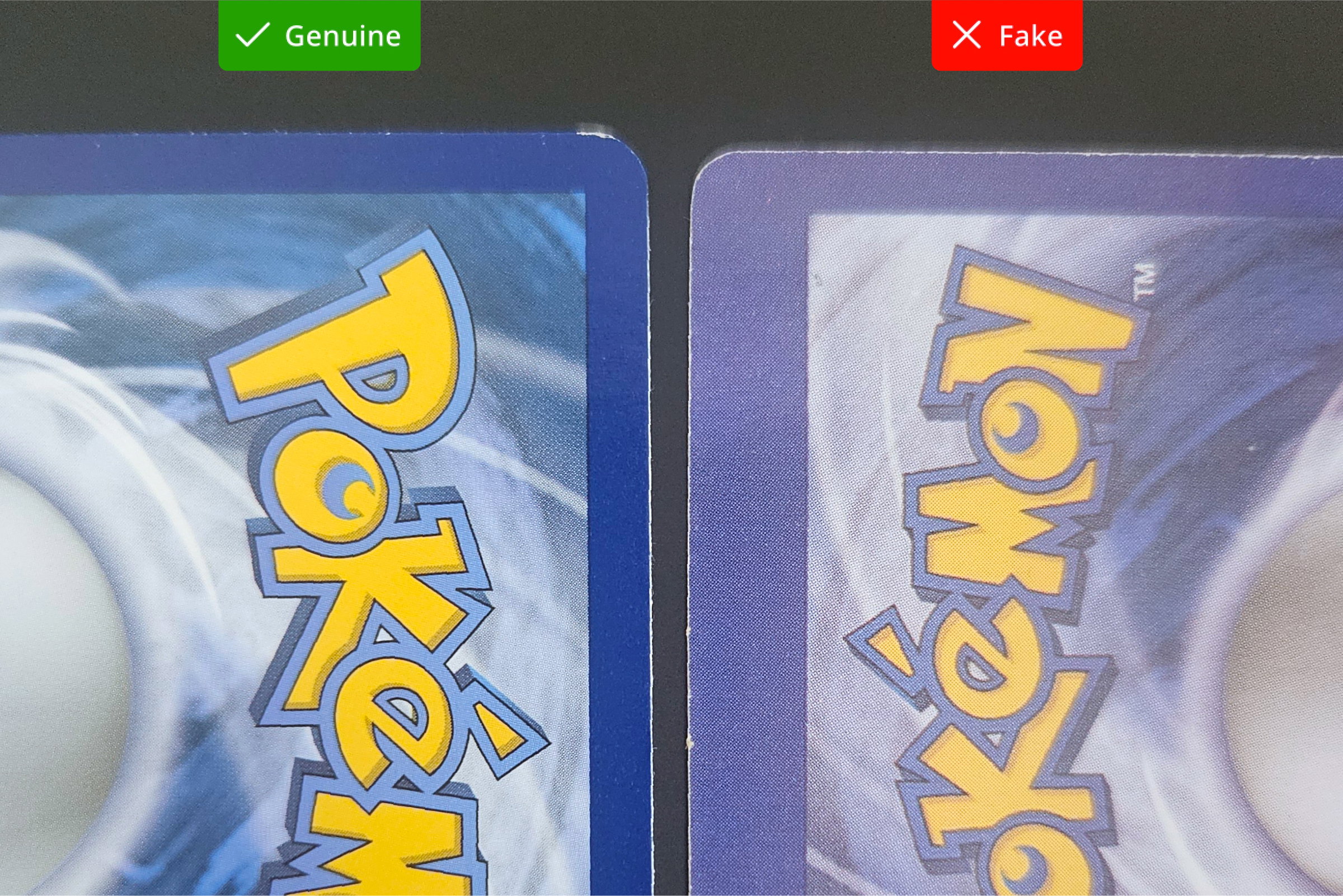
Miscut corners or edges
Poorly cut, uneven, or rough corners and edges can be (but are not always) a sign of a forged reproduction.
Genuine trading cards should have smooth, evenly cut edges and neatly rounded corners, with official English Pokémon cards having a standard corner radius of around 3mm. On the other hand, counterfeit cards may have poorly cut, frayed, or jagged corners and edges, sometimes with visible cardboard residue. It’s important to note that, when compared to Japanese cards, English cards are generally less consistent in their cutting, and may not always be perfectly smooth or rounded. Because of this, it would be unwise to judge if a card is real based on the corners and edges alone, but irregular cuts can still be a potential red flag.
Over or under sized card
Forged cards are often slightly over or under-sized when compared to genuine copies, which have very consistent dimensions.
English Pokémon and Magic: The Gathering cards share the same standard card size of 2.5 x 3.5 inches (63.5 x 88.9 mm), while Yu-Gi-Oh! cards are notably smaller, measuring 2.3 x 3.3 inches (59 x 86 mm). Whilst you can use specialist tools like a digital caliper to measure a card to 0.01 mm accuracy, it’s far easier to just place it on top of a known real card - even tiny size differences will be obvious to spot. Just remember there can be some variance in the cut of cards so we don’t recommend solely relying on size difference as a fake tell unless it’s very apparent.
Material
Poor quality card stock
Fakes are often printed on low-quality card stock that can feel flimsy, paper-like or overly glossy compared to real cards.
Genuine cards are printed on high-quality, layered stock that is firm, durable and usually has a professional glossy finish. The cards are designed to withstand the regular handling that comes with gameplay and trading without bending or wearing too easily. This stock is not readily available to most counterfeiters, so fakes often rely on cheaper and lower quality substitutes. As a result, fake cards may feel thinner, flimsier or excessively glossy, and their edges may wear down more quickly than a genuine card would. Simply comparing the feel and finish of a suspect card against one you know is genuine can reveal these differences in quality.
Missing emboss or deboss
If an authentic copy of a card features an emboss (raised) or deboss (indented) area, it is unlikely to be reproduced on forged versions.
Embossing and debossing are 3D-like effects often used to highlight artwork, text or icons, giving the card a more premium look and feel. These special effects are difficult and expensive to reproduce as they require specialist equipment and techniques, so fake cards will usually lack these details altogether. If a card that should feature embossing or debossing lacks these effects entirely, it is a clear indication that the card is a counterfeit.
Wrong or missing texture
Accurately copying texture from cards is difficult and expensive for counterfeiters, so look out for incorrect or altogether missing textures.
Another strong indicator of authenticity is the texture of the card. Many genuine trading cards, particularly special or rare ones, are printed with grainy, patterned or even fingerprint-like textures. This is difficult and expensive for counterfeiters to replicate, so they will often miss this out entirely, leaving the surface flat and smooth. We are, however, starting to see more fakes around that present with textured effects but thankfully the patterns tend to be inconsistent with those on a genuine version. If a card you are checking is supposed to have a texture but doesn’t, or has the wrong pattern, it is a clear sign that it may be a fake.
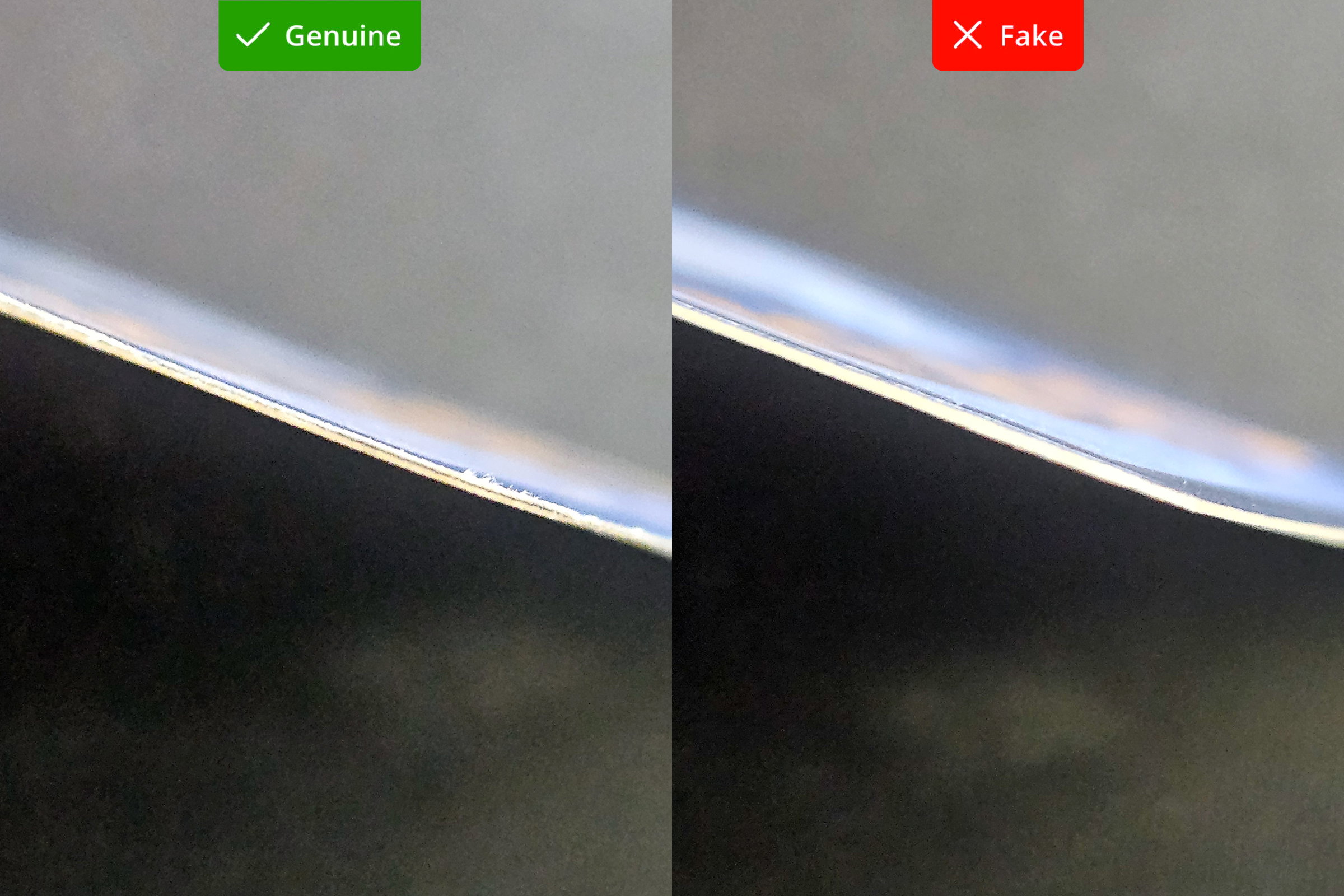
Missing middle layer (Pokémon)
Genuine Pokémon cards have a thin dark layer of card sandwiched between two white layers. This is normally missing on fakes.
Pokémon cards aren’t just a single piece of card - they’re made from three distinct layers glued together. The middle layer is especially important for identifying fakes, as many counterfeits leave it out entirely. This layer provides strength and snap to the card, helps bond the outer layers, and prevents light from passing through. The most reliable way to check for this is to examine the card from the side, where the thin middle layer should be visible (black/dark-grey on English cards or blue/grey on Japanese), sandwiched between the two white outer layers. Another common but less reliable test is to shine a torch behind the card, as the middle layer should block most of the light from shining through, although modern fakes (particularly holofoils) can sometimes pass this test. And while not recommended, tearing a card in half will certainly reveal whether the middle layer is there - but maybe keep this one as a last resort!
Card specific
Wrong or missing holo
Fake holo cards often feature the wrong holo pattern, a flat shine over the whole card or are missing a holo effect altogether.
Found on…
- Holofoil
The holo (or “holofoil”, ”shiny”) effect, usually found on rare or special cards, is one of the most challenging aspects for forgers to get right. There are various kinds of holo, but in general the effect creates a reflective, shimmering surface on part or all of a card, which changes appearance as you turn it in your hands. Forgers may leave out the holo effect entirely, but when they do try and recreate it, there are many potential pit-falls that can reveal the card as an imitation.
Most genuine holos use the effect to highlight certain areas, such as the character or player. On a fake, you might find the holo effect applied to the wrong part of the – or all of – the card. A Pokémon’s card described as “reverse holo” flips this on its head and instead features a holo effect that covers all but the key area of the card.
A good tip for modern cards is to look at the angle of the holo effect against a genuine card. It might be vertical where the real deal is diagonal, or the other way around. With sparkling effects, fakes often exhibit a flat or overly uniform holo causing the sparkles to shimmer all at once when turned. The patterns revealed by the light may also be wrong in shape or scale, or include designs like flowers or hearts.